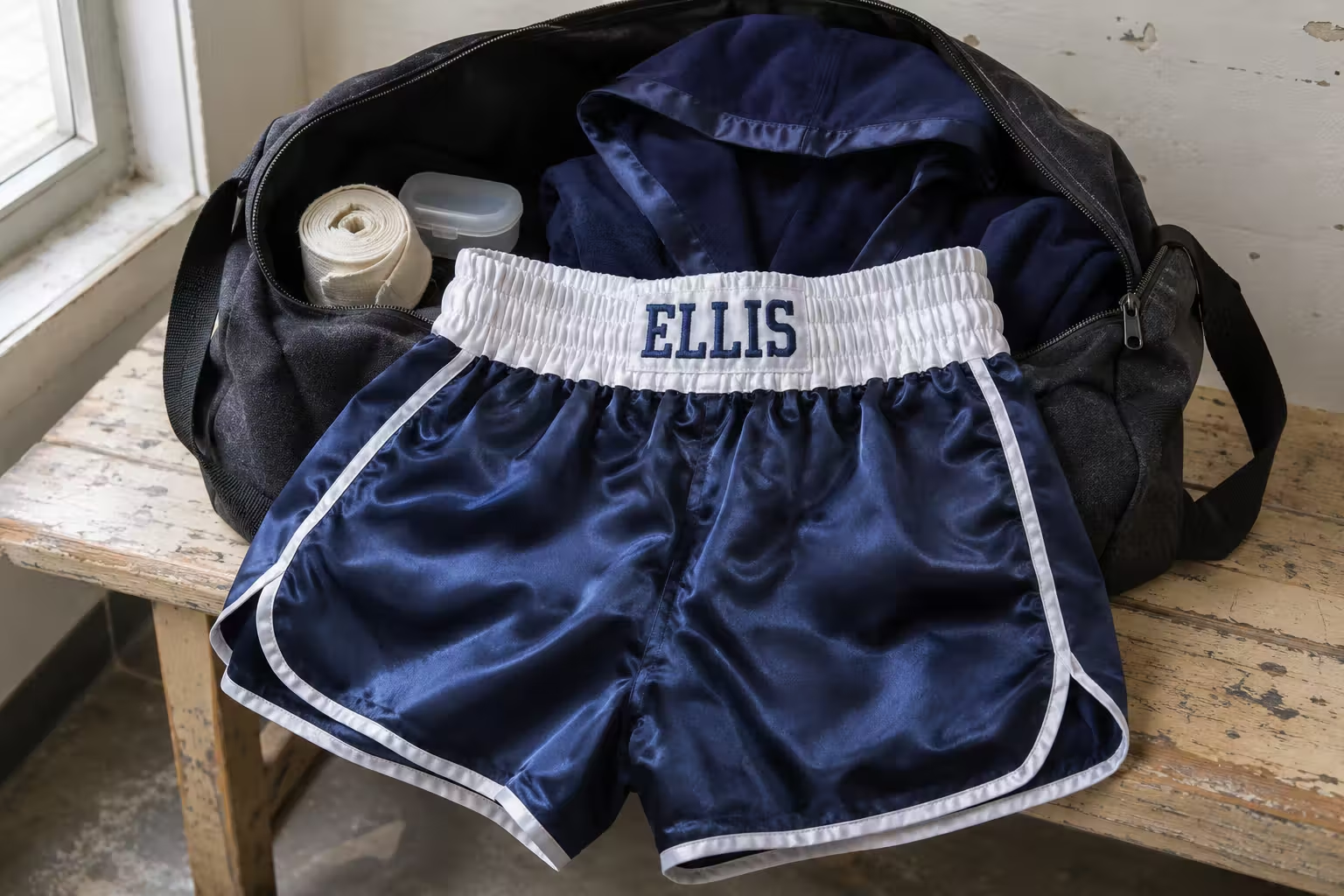
White-Collar Boxing Kit Checklist
White-collar boxing kit splits into what you wear, what protects you and what you bring. The organiser's rules decide the final list, so check them first.
| Item | Usually needed? | Who provides it | Notes |
|---|---|---|---|
| Boxing shorts | Yes | You | Waistband in a contrasting colour |
| Vest or top | Often | You or the organiser | Check the corner colours you are given |
| Robe | Optional | You | For the ring walk |
| Gloves | Yes | Often the organiser | Ask whether you bring your own |
| Head guard | Often | Often the organiser | Many events require one |
| Gum shield | Yes | You | Fitted, ideally a boil-and-bite or custom-moulded guard |
| Groin guard | Yes | You | Worn under the shorts |
| Hand wraps | Yes | You | Check whether officials wrap or inspect them |
| Boxing boots or trainers | Yes | You | Flat soles, no studs |
Bring spares of the small items, a water bottle and a towel, and pack the night before.
Shorts and Dress Code
White-collar dress codes follow amateur boxing in most events: shorts that reach at least mid-thigh, a waistband below the navel that marks the belt line, and a vest or top if the organiser asks for one. England Boxing's rules require a red, blue or white sash when the waistband matches the shorts, and many white-collar events borrow that standard.
Fight-night shorts are where white-collar fighters show personality: a fight name across the waistband, bold colours and trims such as tassels. The boxing kit rules guide explains the amateur standards in full.
Robes and Ring-Walk Outfits
The ring walk is the moment the crowd sees you first, and a robe makes it count. A satin robe with your fight name across the back, in the same colours as your shorts, turns a charity bout into a proper fight night.
Order the robe with your shorts so the colours and lettering match exactly on one proof. Hooded robes suit a dramatic entrance; open robes show off the shorts underneath. The custom boxing kit page covers robes, vests and full sets.
Training Camp Kit vs Fight-Night Kit
Training camp kit and fight-night kit overlap, but fight night adds the pieces the crowd sees.
| Item | Training camp | Fight night |
|---|---|---|
| Gloves | Your own, usually 14oz or 16oz for sparring | Event gloves, often supplied by the organiser |
| Head guard | Your own sparring guard | Event head guard, often supplied |
| Shorts | Any training shorts | Custom fight shorts with your fight name |
| Top | T-shirt or vest | Vest or top in the colours the event asks for |
| Robe | None | Optional, for the ring walk |
| Gum shield, groin guard, wraps | Your own | The same ones you trained in |
Never wear new protective kit for the first time on fight night. Train in the gum shield and groin guard for several weeks, and try the custom shorts on over the guard as soon as they arrive.
Protective Kit
Protective kit keeps white-collar boxing safe, and most events specify it:
- Head guard: most white-collar events require one, and many supply them.
- Gum shield: fit it well before fight night and train in it.
- Groin guard: worn under the shorts; choose your shorts size with it on.
- Chest guard: optional for women; check the event's rules.
- Gloves: the organiser specifies the weight and often supplies them.
Measure for your shorts over your groin guard, because the shorts sit over it on the night. The size guide explains how.
Kit for Women Fighters
Women in white-collar boxing wear the same core kit, with a few choices of their own:
- Shorts: the women's cut, with a shaped waist and a shorter leg.
- Chest guard: optional under England Boxing rules (8.4.2); check what the event allows.
- Top: a vest or close-fitting top, which white-collar events usually ask women to wear.
- Skin coverings and hijab: England Boxing allows black, close-fitting, non-padded coverings declared at the weigh-in (8.1.5). White-collar organisers set their own policy, so ask.
Charity and Sponsor Branding
Most white-collar events raise money for charity, and fight kit is the most visible place to thank the people who back you.
Put the charity logo on the outer leg of the shorts and on the robe, sponsor names on the back of the waistband, and keep the front of the waistband for your fight name. Ask the charity for its logo file and brand rules, and check that the event allows sponsor branding. The guide to adding sponsor logos covers file types and placement.
Choosing a Fight Name
A fight name gives your shorts, robe and ring announcement a personality. Good white-collar fight names are short, easy to say over a microphone and recognisable to the friends and colleagues in the crowd.
- Keep it to one or two words, about 12 characters, so it fits the waistband.
- Build it from your job, your town or a well-known nickname.
- Say it out loud with "In the red corner" in front of it.
- Check the spelling on your proof before you approve it.
Questions to Ask the Organiser
The organiser's rules decide your final kit list, so ask these questions before you order anything:
- Which gloves and head guards do you supply, and what glove weight do fighters use?
- Is a vest or top required, and in which colours?
- How are corners assigned, and when do fighters find out?
- Are sponsor names and charity logos allowed on shorts and robes?
- Are robes allowed for the ring walk?
- Which medical checks or forms do fighters complete before the event?
Write the answers down and design your kit around them. The answers to questions two and three decide your shorts and vest colours.
When to Order Your Kit
Order custom white-collar kit at least four weeks before the event. Production takes 13 working days after proof approval, the proof takes up to 24 hours and delivery adds 2 working days.
The best moment to order is when you choose your fight name, early in the training camp, so the kit is never a last-minute worry. The guide to how far in advance to order fight shorts has the planner and the faster options. Design your custom boxing shorts and robe together, and walk out on fight night in kit that matches.
Packing Your Fight-Night Bag
Pack your fight-night bag the night before, with this list:
- custom shorts, plus a red, blue or white sash if the waistband matches the shorts
- vest or top, and the robe for the ring walk
- groin guard and, for women, a chest guard if you wear one
- gum shield in its case, and a spare
- two pairs of hand wraps
- boxing boots or flat-soled trainers, and socks
- towel, water bottle and a warm layer for after the bout
- the event's paperwork, photo ID and any medical forms the organiser asks for
Leave the gloves at home if the organiser supplies them, and label everything with your name.
White-Collar Kit FAQs
What should I wear for white-collar boxing?
Wear boxing shorts with a contrasting waistband, a vest or top if the organiser requires it, a groin guard, a gum shield and boxing boots or trainers.
Do I need my own gloves for white-collar boxing?
Not always. Many organisers supply gloves and head guards. Ask before the event.
Can I wear a robe for the ring walk?
Yes. Most white-collar events welcome robes for the ring walk. Remove it before the bout starts.
Is there a dress code for white-collar boxing?
Yes. Most events follow amateur-style dress, and the organiser sets the final rules.
Should I train in my fight shorts?
No. Keep custom fight shorts for fight night and the photos. Train in ordinary shorts, and try the fight pair on once over your groin guard.
Do women need a chest guard for white-collar boxing?
No. England Boxing makes the breast protector optional, and white-collar organisers set their own rules, so check with the event.
How many pairs of hand wraps do I need?
Two. Pack a clean spare pair in case the officials re-wrap your hands or a wrap gets wet.