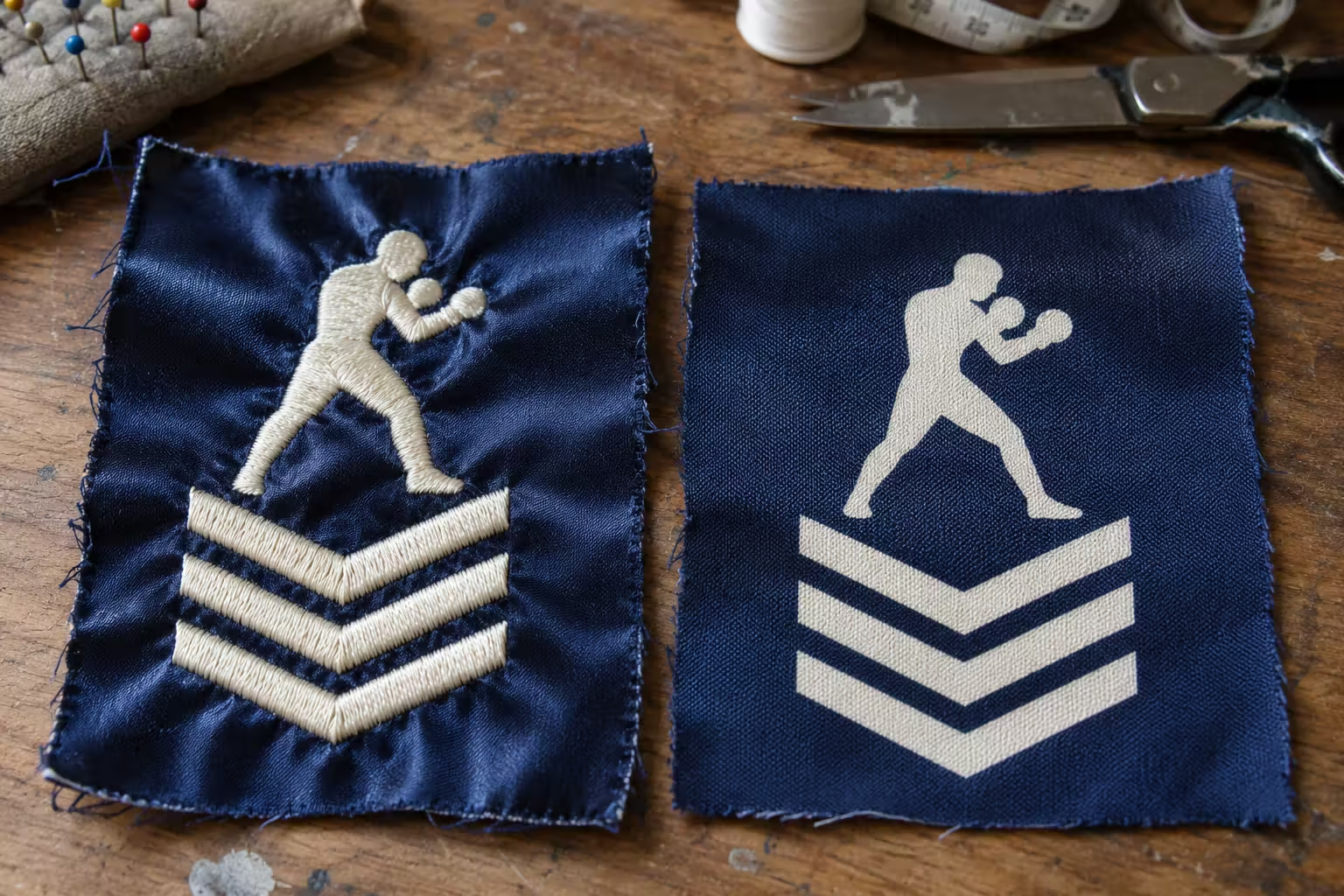
How Embroidery Works
Embroidery stitches coloured thread through the fabric to form letters, logos and shapes. A digitised version of the artwork tells the embroidery machine where every stitch goes, and the machine sews thousands of stitches over a stabiliser that keeps the satin flat.
Embroidery has three finishes on boxing shorts:
- Flat embroidery: tight satin stitches that sit close to the fabric, for names and simple logos.
- 3D raised embroidery: stitches over a foam base, so letters stand off the fabric.
- Outline embroidery: a contrasting border around letters, which keeps names readable from ringside.
Embroidery is the most durable decoration method. The thread is part of the garment, so it survives repeated washing and the friction of training.
How Sublimation Works
Sublimation prints artwork onto transfer paper with special inks, then uses heat and pressure to turn the ink into a gas that bonds into polyester fibres. The ink becomes part of the fabric, so the print has no surface layer to crack or peel.
Sublimation reproduces anything a printer can print: photographs, gradients, camouflage, fine detail and unlimited colours. It has two limits. It bonds only to polyester, and it works on white or light fabric, because the ink is transparent and cannot print light colours onto dark fabric.
Sublimation on Dark Shorts
Sublimation prints dark designs by printing the dark colour itself onto white polyester.
Sublimation ink is transparent, so it never lightens a fabric. A black design still works: the whole design, including the black background and every light detail, is printed onto white fabric in one pass, and the white of the fabric shows wherever the design is white. All-over prints have one side effect: a thin line of white sometimes shows at seams and where the fabric stretches.
| Fabric | Embroidery | Sublimation |
|---|---|---|
| White or light polyester satin | Yes | Yes |
| Coloured or dark polyester satin | Yes | Only on a white or light panel, or as an all-over print on white |
| Leatherette (PU) | Yes | No; sublimation bonds only to polyester fibres |
Dark shorts with a full-colour sponsor area usually combine methods: a printed panel on light polyester for the artwork and embroidery for the name. Your proof shows how each part of your design is made.
Appliqué and Tackle Twill
Appliqué cuts letters and shapes from fabric and stitches them onto the shorts around the edge. Tackle twill is appliqué in a sturdy twill fabric with a zig-zag edge stitch, the method used on sports jerseys.
Appliqué covers large areas faster and lighter than dense embroidery, so it suits big lettering across a leg panel. It combines well with embroidery: an appliqué letter with an embroidered outline gives a layered, premium look.
Side-by-Side Comparison
| Attribute | Embroidery | Sublimation | Appliqué |
|---|---|---|---|
| Look | Raised thread, sharp edges | Flat, full colour | Layered fabric letters |
| Feel | Textured | No feel; part of the fabric | Slightly raised |
| Detail | Bold shapes and text | Unlimited detail and colours | Large, simple shapes |
| Colours | One thread colour per area | Unlimited, including gradients | One fabric colour per piece |
| Fabric | Any fabric | Light polyester only | Any fabric |
| Durability | Highest | High; does not crack or peel | High |
| Best for | Names, simple logos | Photos, camo, complex sponsor art | Large lettering |
| Price per pair | Included for names | +£8 | +£6 |
Which Method for Names, Logos and Art?
Match the method to the artwork:
Names and nicknames
Embroidery is the right choice for names. It reads clearly, lasts longest and is included in the price. Choose 3D embroidery or a crystal outline for extra presence; the lettering styles guide compares fonts and finishes.
Club badges and simple logos
Embroidery suits logos with bold shapes, few colours and no tiny text. Logos with fine lines or small lettering lose detail in thread, and those suit sublimation.
Sponsor logos and full-colour art
Sublimation suits detailed sponsor logos, photographs, flames, gradients and camouflage. It suits fully printed designs where the whole short is one image. The guide to adding sponsor logos explains placement and artwork files.
Big lettering across the leg
Appliqué suits large words and numbers, especially on retro long-leg shorts with room down the thigh.
Preparing Artwork for Each Method
Each method needs artwork in a different form, and the right file saves a round of proof changes.
- Embroidery: bold shapes and text at least about 6 mm tall. Lines thinner than about 1 mm disappear in thread. The artwork is converted into a stitch file, so a vector file or a clean, high-resolution image gives the sharpest result.
- Sublimation: artwork at print size and 300 dpi, or a vector file. Screen colours shift slightly in print, so name Pantone references for brand colours.
- Appliqué: simple, bold shapes with no fine detail, because each piece is cut from fabric. Vector outlines give the cleanest cut.
Send the original logo file rather than a screenshot or a social-media image, which blurs when enlarged.
Durability and Care by Method
Embroidery is the hardest-wearing method, sublimation never cracks or peels, and appliqué edges are the one area that needs gentle handling.
- Embroidery: wash inside out so the stitches do not snag, and never iron directly over thread.
- Sublimation: keep high heat off the print, because heat is what bonds the ink and too much of it moves the ink again.
- Appliqué: wash inside out on a gentle cycle, so the cut edges stay sealed under the edge stitch.
The care table in the fabrics guide covers every fabric and trim.
Methods for Club Orders
Club orders get the best result from embroidery for anything that changes per boxer and from one consistent method for anything shared.
Embroider each boxer's name, so every pair carries its owner's name at no extra cost. Embroider the club badge when it has bold shapes and few colours, and sublimate it when it has fine detail, gradients or a full-colour sponsor, because sublimation costs the same whatever the artwork (£8 per pair). The club and team orders page explains the bulk prices.
Cost Differences
Embroidered names cost nothing extra, because name embroidery is included in every pair. Each embroidered logo adds £8, sublimation adds £8 per pair and appliqué adds £6.
Embroidery cost rises with stitch count, so a large, dense logo costs more to stitch than a small one. Sublimation cost stays the same whatever the artwork, which makes it good value for detailed designs. The price list shows every add-on.
Can You Combine Methods?
Yes. Many fight shorts combine methods: sublimation for a full-colour leg panel, embroidery for the name on the waistband and appliqué for a large number or word. Each method does the job it does best.
Combined designs start from a light polyester base wherever sublimation appears. Your digital proof shows which method is used for each element before production. The fabrics and decoration guide compares every fabric, and you can start a combined design for your personalised boxing shorts in the online designer.
Embroidery vs Sublimation FAQs
Is embroidery better than sublimation?
Neither is better overall. Embroidery suits names and bold logos; sublimation suits full-colour, detailed artwork.
Does sublimation work on black shorts?
No. Sublimation ink is transparent, so it needs white or light polyester. Dark areas are printed as part of the design.
Does embroidery come off in the wash?
No. Embroidery is stitched through the fabric. Wash cool and inside out to keep the thread bright.
Which method lasts longest?
Embroidery lasts longest. Sublimation also lasts well because the ink bonds into the fibres and cannot peel.
Can you sublimate onto leatherette?
No. Sublimation bonds only to polyester fibres, so leatherette shorts carry embroidered names and logos instead.
Which method is best for a club badge?
Embroidery, when the badge has bold shapes and few colours. Sublimation suits badges with fine detail or gradients.
Can I mix embroidery and sublimation on one pair?
Yes. Many fight shorts sublimate a full-colour panel and embroider the name on the waistband.